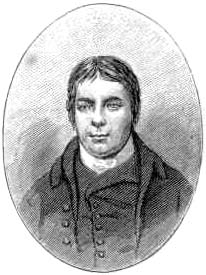
Andrew Fuller the Preacher

April 9, 2007

fuller.jpg

While Fuller was a very popular preacher, it is well-known that he was perhaps not the best preacher. In doing some reading and thought into Andrew Fuller the Preacher, I came across some interesting quotes in which everyone may be interested.

“His own sermons were weighty, logical, and grave; he had not the finish of Foster not the splendor of Hall, but his simple and vigorous style expressed simple and vigorous thought; that he was an effective preacher may be inferred from the fact that when Thomas Chalmers listened to him he resolved to so far make Fuller model that he would never again read a sermon, but henceforth trust to extemporaneous delivery” (T. Harwood Pattison, The History of Christian Preaching [Philadelphia, PA: American Baptist Publication Society, 1903), p. 287.

“There is little warmth–no heat; imagination is scarcely in evidence at all; and ‘flights of eloquence’ nowhere appear. The sermons on themes are orderly, discriminating, logical; the expositions… are careful and plain, in homily form; the style is clear and even, but lacks grace, fervor, and movement. Excellent good sense and timeliness for their day characterize the writings of Fuller, and they did good and enduring service; but they have not enough literary quality to make them standards, and their adaptation to contemporary though has, or course, passed away with their own times” (Edwin Charles Dargan, A History of Preaching [New York: George H. Doran, 1912], II:333).

“As a preacher he soon became popular, without any of the ordinary means of popularity. He had none of that easy elocution, none of that graceful fluency, which melts upon the ear, and captivates the attention of an auditor. His enunciation was laborious and slow; his voice strong and heavy; occasionally plaintive, and capable of an agreeable modulation. He had none of that eloquence which consists in a felicitous selection of terms, or in the harmonious construction of periods; he had a boldness in his manner, a masculine delivery, and great force of expression. His style was often deformed by colloquialisms, and coarse provincials; but in the roughest of his deliveries, ‘the bones of a giant might be seen.’… In entering the pulpit, he studied very little decorum, and often hastened out of it with an appearance of precipitation… Not aware of its awkwardness, in the course of his delivery, he would insensibly place one hand upon his heart, or behind him, and gradually twist off a button from his coat, which some of his domestics had frequent occasion to replace…. He was not the exact model of an orator” (J. W. Morris, Memoirs of the Life and Writings of the Rev. Andrew Fuller, late Pastor of the Baptist Church in Kettering, and Secretary to the Baptist Missionary Society (n.o. High Wycomebe, 1816), pp. 81-82).

These are just a few looks at Fuller’s pulpit ability. Yet, for Fuller it was passion in the pulpit over rhetorical and oratorical skill that he rightly stressed was important for the preacher.


Art and Soul: Spirituality and the Aesthetic – The Andrew Fuller Centre for Reformed Evangelicalism Lectures

April 9, 2007

coppengermark.jpgcao16f0x.jpg

The Andrew Fuller Centre for Reformed Evangelicalism would like to present its annual lecture series. This year, Dr. Mark Coppenger will be lecturing on Art and Soul: Spirituality and the Aesthetic. It will be held June 2, 2007 at Grace Bible Church, Cambridge, ON.

Dr. Coppenger is pastor of Evanston (IL) Baptist Church and Distinguished Professor of Christian Apologetics at The Southern Baptist Theological Seminary. He has been a Wheaton College philosophy professor, executive-director of the State Convention of Baptists in Indiana (SBC), founding editor of SBC LIFE, and president of Midwestern Baptist Theological Seminary. He has a Ph.D. from Vanderbilt and an M.Div. from Southwestern Baptist Theological Seminary.

The cost of the lectures is $30. The breakdown of the lectures is as following:

9:30 AM – 10:30 AM – “The Soul of Art”
10:30 AM – 11:00 AM – Break
11:00 AM – 12:00 PM – “The Soul of the Artist”
12:00 PM – 1:30 PM – Lunch Break
1:30 PM – 2:30 PM – “The Soul of the Viewer”

If you would like to attend please send your name, address, telephone number, e-mail and a cheque or money order for $30 (Canadian funds, made out to Toronto Baptist Seminary with “Fuller Lectures” in memo line) or VISA/Mastercard information to:

Andrew Fuller Centre for Reformed Evangelicalism
c/o Toronto Baptist Seminary and Bible College
130 Gerrard Street East
Toronto, ON M5A 3T4
416-925-3263 (phone)
416-925-8303 (fax)
allen.mickle@tbs.edu


“Listening to the Past – Lessons from Andrew Fuller” 13

April 1, 2007

fuller.jpg

This past week in chapel, Pastor Carl Muller of Trinity Baptist Church, Burlington, ON, brought us the Word of God with a focus on the Christian and joy. It was a good reminder of what the inward and outward disposition of the Christian is to be! Andrew Fuller also wrote on the issue of the Christian and joy. In a circular letter of 1795 (titled, “Why Christians in the Present Day Possess Less Joy than the Primitive Disciples”) Fuller discusses the reasons why Christians do not experience joy and some solutions for the problem.

The quote from this letter can be found in the Works, III:330.

“The primitive Christians were in the habit of considering all things as working together for good, and so of deriving joy from every occurrence. If the world smiled upon them, they rejoiced, and availed themselves of the opportunity for spreading the gospel; of if it frowned on them for their attachment to Christ, they rejoiced that they were counted worthy to suffer shame for his name’s sake. By thus converting every thing into food for joy, they answered to the exhortations of the apostles, ‘Let the brother of low degree rejoice that he is exalted; but the rich in that he is made low.’–‘Beloved, count it all joy when ye fall into divers temptations.’–‘Rejoice evermore.’–In everything give thanks.’ If we would feel like them, we must enter into their views; we must have less of the complaining patriarch, as well as the whining merchants; and more of that temper which prompted the holy inhabitants of heaven, on every new dispensation of providence, to cry, ‘Amen Hallelujah!'”


A Question in Baptist Historiography

April 1, 2007

This has come up on another blog so I figured I would address the issue here. A question of historiography arises in Baptist History particularly in the life of William Carey. Many take it to be a cut and dry issue but it is hardly. Let’s start with some context around the question.

William Carey (1761-1834), affectionately known as the “Father of Modern Missions,” in 1785 met with other men from churches in what was called the Northamptonshire Association. These regular meetings were a time for exchanging of ideas, fellowship, and spiritual encouragement. At this meeting it was asked for someone to propose a topic for discussion. Carey proposed a theme on which he had given much thought.

“Whether the command given to the apostles to teach all nations was not binding on all succeeding ministers, to the end of the world, seeing that the accompanying promise was of equal extent.”

This is where the question arises. The issue is not with Carey’s question but with the answer that was given to the question. There are a number of options.

John Webster Morris, who was pastor of Clipston Baptist Church in Northamptonshire, who was present at the meeting wrote that John Ryland, Sr.  responded with,

“You are a miserable enthusiast for asking such a question. Certainly nothing can be done before another Pentecost, when an effusion of miraculous gifts, including the gift of tongues, will give effect to the commission  of Christ as at first. What, Sir! Can you preach in Arabic, in Persic, in Hindustani, in Bengali, that you think it your duty to send the gospel to the heathens?”

John C. Marshman, the son of Carey’s co-worker in India, Joshua Marshman, reported that Ryland, Sr. said,

“Young man, sit down. When God pleases to convert the heathen, he will do it without your aid or mine!”

In contrast to these two versions is the response of John Ryland, Jr. about the situation. He denies it even happened.

“I well remember the discussion of this question, which fully occupied the evening. Another had been discussed, after dinner, respecting village-preaching–What was a sufficient call, to attempt introducing it into places where it had not been usual before?–which, therefore, seems to leave no room for that ill-natured anecdote, respecting my father and young Carey, to have taken place this year, which is said to have been before the end of 1786; whereas my father had left Northampton before the Minister’ Meeting in 1786. And I must consider it as very unlikely to have occurred in 1785, for several strong reasons. I never hard of it, till I saw it in print, and cannot credit it. No man prayed and preached about the latter-day glory, morethan my father; nor did I ever hear such sentiments proceed from his lips, as tre there ascribed to him.”

Whatever the facts, it is true that among many Calvinistic Baptists in this period there would have been some who would have uttered these sentiments. The question though is did John Ryland, Sr. utter these kind of sentiments? Ryland was hardly a hyper-Calvinist but it would not have been unusual for even evangelical Calvinists to say similar things. Even Fuller was a little taken aback by Carey’s  proposal. He had himself said, “If the Lord should make windows in heaven, might such a thing be!”

What is the true scenario that happened? Who is to know for sure. But it is one of those interesting questions in Baptist History. Let us not just quote John Marshman’s statement about what happened without stating that there is a debate about this event in the life of William Carey.


My Favourite Baptist History Blogs

April 1, 2007

The benefit of a blog is to be able to share your thoughts with people who do not always get to see you in person. In turn, you get the opportunity to learn from others. Since one of the main focuses of my blog is on Baptist history I wanted to share with you some of my favourite Baptist history blogs. I rank them in no particular order.

Historia Ecclesiastica

Dr. Michael A. G. Haykin, Principal and Professor of Church History and Reformed Spirituality at Toronto Baptist Seminary and Bible College has in my opinion one of the best Church History blogs around. In fact I think he is one of the best Church Historians in the world (and that’s not just because he’s my boss!). His particular areas of expertise are in the Ancient Church, Baptist History, and Spirituality. His blog is carefully thought out, and tremendously applicational!

Nathan A. Finn

Nathan Finn, Ph.D. student in Church History at Southeastern Baptist Theological Seminary is one of the bright up-and-comers in Church History. His insight in particular into the Southern Baptist Convention. He also has a keen interest in 18th century British Baptists which in my opinion is one of the most fascinating areas of Baptist History (and that’s not just because I’m doing my dissertation in that area!). Keep your eye on this blog.

Pastor Steve Weaver’s Blog

Steve Weaver, a Th.M. student at Toronto Baptist Seminary and Bible College and Pastor of West Broadway Baptist Church in Lenoir City, Tennessee. His love for Baptist History is evident in his blog postings especially on Hercules Collins. His being a pastor is also most helpful as he seeks to show how studying Baptist History can actually be life changing!

Praisegod Barebones

Bart Barber’s blog is extremely helpful in understanding Southern Baptist History. He also has a keen interest in areas of British Particular Baptist life which is always great. Plus, I agree with Nathan that he has the best Baptist blog name anywhere! He is gracious and helpful in clarifying complex issues in Baptist History.

Check out all of these blogs. They will help you in your understanding of Baptist History immensely!