Which Baptist History Text?

April 15, 2008

Which Baptist History text would you use to teach your people or your students the tradition of our forefathers and foremothers? When my former boss Michael Haykin was picking his text to use for his Baptist History class at SBTS this semester we had a brief discussion about what was the best Baptist History textbook. Is McBeth too long? Is Torbet too short? Is Oliver too specific?

What are your thoughts? This obviously presumes you would have your students reading primary source material, but what would you have them read when it comes to secondary material? What do you feel is the best Baptist History textbook?


The Discipline of Spiritual Discernment by Tim Challies

February 21, 2008

Greetings bloggers! For your enjoyment, here is a review of Tim Challies new book, The Discipline of Spiritual Discernment, from Crossway done by my father, Allen Mickle, Sr. My father is an M.Div. graduate from Detroit Baptist Theological Seminary and is currently searching for a ministry position. Below now then is his excellent review of this book by Challies.

——————————————————————————————————————-

One of the legacies of twentieth century Evangelical Christianity has been its loss of biblical knowledge. This loss of biblical knowledge has left Christians susceptible to every kind of deception that blows their way resulting in a plethora of counterfeit doctrines. These counterfeit doctrines, like counterfeit money, appear real at first glance. In order to expose them as false, Christians need to discern truth from falsehood, and the way to do this is by practicing spiritual discernment. Spiritual discernment is the skill of thinking biblically about life.

Believing that spiritual discernment is a skill that Christians should seek, Tim Challies, one of the most widely read Christian bloggers has written a book on this discipline. Although the subject is theological, it is written for the average person in the pew. The book is clear and simple to understand, teaching how to discern error rather than just compiling lists of dos and don’ts.

Challies begins his book by showing the reader the need to develop spiritual discernment and the folly of ignoring it. He discusses the challenges of being a discerning Christian in this day and age. Those who discern truth from error face great opposition from satanic forces and cultural influences. In chapter three, he defines spiritual discernment as the skill of understanding God’s Word with the purpose of separating truth from error. Challies teaches that Christians, empowered by the Spirit, are to strive to understand what is pleasing to God, through the Bible and then apply it to their lives. Once Challies has defined discernment he has the reader focus on its use. Spiritual discernment should be used to test everything associated with the Christian’s life, but its primary focus should be on what God teaches about Himself and how He calls us to live. Knowing God and His will for our lives will lead us to think right about Him and to avoid having a heart that is focused on the world. Discerning the will of God through His revealed Word should give us delight as we apply it to our lives.

In chapter seven, Challies discusses how spiritual discernment is one of the gifts of the Spirit that brings unity to the church as it is used in serving other Christians. While every Christian should strive to discern truth from error, some have been gifted specifically in this area and they should be using this gift in their local church to watch out for false doctrines that continually bombard its members. But Challies also warns his readers about the pitfalls of practicing discernment. It must be practiced with the proper motives and not become a tool of self glorification. It must not be wielded as a method of putting others down, but for the good of all Christians in love. The book finishes by describing the character of a believer who wishes to be discerning, and concludes with a step by step process that leads the reader through the practice of spiritual discernment.

Tim Challies has written an excellent book on a topic that has little written about it today. The evangelical church is rife with false doctrine, and this book fills a need in teaching Christians how to discern truth from error. The book is a must for every Christian to read and would make a great study for a Sunday School class or Bible study.


Culture Shift by Al Mohler

January 21, 2008


Rarely do I pick up a non-fiction book and cannot put it down. Yet, when I picked up Al Mohler’s new book, Culture Shift, I could not put it down until I was done reading it. Granted, the book is really a brief introduction to Christianity’s influence on practical cultural issues (only 160 pages) but it was not the low amount of pages that made it a must-read, it was rather the content that was life changing for me.

Mohler, one of the greatest minds in the Evangelical church today, is President of The Southern Baptist Theological Seminary, Louisville, KY. And while this may be his first book, it is hardly his first foray into writing. Amongst a plethora of articles and chapters for books, Mohler has an almost daily blog that deals with many cultural issues and how Christians are to respond. In fact, many of these chapters in his book, Culture Shift, were originally written for his blog. But, even if you have read these before, you must read them again.

We as Christians, Mohler notes, often take two approaches to our involvement with culture. Some take the extreme of non-involvment. For instance, hard lined Classical Dispensationalists may argue that we as Christians have no real responsibility to transform culture at all apart from the proclamation of the Gospel. Whereas, on the other side liberal theology becomes so involved with transforming culture that they neglect the actual mission of the church; evangelism.

So, the first thing that Mohler does in his book is articulate issues of culture, engagement, and the Christian’s responsibility to culture. The first five chapters then seek to introduce these issues, and defend a Christian’s engagement and involvement in culture and to denounce the concept of a purely secular culture. Mohler then begins to engage various issues with logical clarity, an unparalleled knowledge of society’s best writers, and an unfailing adherence to the Scriptures.

Mohler discusses areas of offence, the role of the Supreme Court on religion, terrorism, public schools, the God gene, parenting, dishonesty, abortion, natural disasters and God’s sovereighty, nuclear war, and racism. In each chapter Mohler surveys the writings of some of America’s greatest writers, praising them where they are correct, criticizing them where they are wrong. He clearly interacts with the issues and then responds with Scripture where it applies. While these are not in-depth critiques of cultural issues, they are tantalizing surveys of the issues. I found myself many times thinking I needed to read the book Mohler was talking about in a particular chapter.

You may not agree with Mohler on every issue. For instance, on the use of torture especially in terrorism cases I am not sure I agree with a blanket ban on the use of torture as in the McCain amendment. But I am willing to be persuaded by further study. On the other hand, I think Mohler is right on with the issues of our coddling of our children, the maintaining of both God’s sovereignty and His benevolence when we talk about national disasters, and the renewed effort we need to make in the pro-life movement.

Overall, I found Mohler’s book challenging and enlightening. It really challenged my thinking as to my involvement in culture and my role as a member of the body of Christ in transforming culture for Christ. Every Christian should read Mohler’s book. They should devour it in one sitting and then sit down and chew over every issue. This book will challenge you and spur you on to further study of the issues. Overall, it will challenge you to truly live as a light for Christ in a dark world. Mohler has hit a home run with this book and I hope he continues writing more on this subject as it is desperately needed in the church today. Cannot be more highly recommended.


Now Available!

January 1, 2008


The Discipline of Spiritual Discernment by Tim Challies is now available from Crossway books. Check it out here. This book should prove to be very fantastic. Tim is one the most widely read blogger out there in Evangelical circles and is a Torontonian to boot! You can check out his blog here. You can see reviews of the book here on Tim’s site. I pre-ordered a signed copy from Tim and cannot wait to get it in my hands and read it! I think it will prove to be in the top 10 of many people’s Top Books of 2008 lists even though technically it was from 2007. So, if you care about growing in your spirituality then get Tim’s book now and read it this holiday season!


Great Themes in Puritan Preaching

November 22, 2007

Preaching today is anemic at best and thoroughly unbiblical at worst! There is a solution! Learn from the past about what makes great preaching! Mariano Di Gangi has helped us by looking at the Puritans on preaching. Di Gangi, author of the new book Great Themes in Puritan Preaching from Joshua Press, is well known in Evangelicalism today having served in a number of well-known churches and taught in a number of schools. He received his M.Div. from Westminster and a D.D. from Gordon Conwell. He was written a previous book on the Puritans titled, A Golden Treasury or Puritan Devotion (P&R, 1999). With recommendations by Derek W. H. Thomas, John MacArthur, Jerry Bridges, and Joel R. Beeke and a forward by Michael A. G. Haykin, this book is surely to become a big hit! On a side note, Joshua Press will be distributing 6000 copies of this book to the Together for the Gospel 2008 conference attendees!

The table of contents reads as follows:

The infallible Word
No upstart sect
The Messiah revealed
Pastoral ministry
Guilt and grace
The second birth
Radical repentance
Justified and sanctified
Spiritual conflict
Bread and wine
Renewal and reform
Family values
Most blessed assurance
Advent to judgment

Below is the introduction of the book reproduced in whole to whet your appetite and encourage you to go out and buy this book (reprinted by permission of Joshua Press)! It is available from Sola Scriptura Ministries International. It is available in paper back or hard cover. Check out the website for Joshua Press for their other titles.

———————————————————————————————————————

Puritans have been caricatured by their critics as advocates of “the narrowest and most inquisitive clerical intoleranc, a gloomy Calvinism in doctrine, Sabbatarianism in practice, and a degrading mental slavery to the mere letter of the Bible.” “Where once one might be accustomed to see an altar, leading his thoughts straightway to Jesus and to ‘the Lamb in the midst of the elders as it had been slain,’ he sees a cushioned pulpit… The noble liturgies of the early church have given way to the extempore effusions of an individual. The place of worship seems to have become a preaching house… Catholicity appears to have yielded to a bald French Calvinism, capable of imagining nothing but a sermon.” The Puritans were suspected of having “one eager all-absorbing passion–to Calvinize the Church of England and assimilate its polity and ritual–in all respects–to those of Scotland and Geneva.”

Undoubtedly, there may have been Dissenters whose extremist excesses produced intolerance rather than renewal in the turbulent decades that followed the Reformation. The fact remains, however, that “Puritanism aimed at a radical purification and reconstruction of church and state on the sole basis of the Word of God, without regard to the traditions of men… Radical in its antagonism to the medieval church, it was a revolution and it ran into the excesses of a revolution.

The Puritans were people of austere morals, reformed in doctrine, and nonconformists in practice when confronted with the imposition of ceremonies and customs not commanded in the Scriptures. Puritan preachers did not major in minors. They would not trivialize the tremendous truths that had the power to change lives. Building on the Nicene Creed, the Apostles’ Creed, and the Christology of Chalcedon, they strongly opposed Pelagianism, Arminianism, and the Socinianism that eventually spawned Unitarianism. They also differed from the Antinomians who depreciated the authority o God’s moral law. Now would they compromise with the Semi-Pelagians who diluted the gospel of sovereign grace with doses of human merit.

Puritan theology expressed in the Westminster Confession of Faith (1643-1648) and the Savoy Declaration (1658), was also in harmony with the Scot’s Confession (1563), the Belgic Confession (1561) and the Heidelberg Catechism (1563) of the Reformation era. The Puritan movement was distinguished by a serious study of the Scriptures and the practical application of biblical doctrines. Accurate exegesis prepared the way for lively exposition and relevant conclusions. Puritan preachers “emphasized the importance of words in the text of Scripture… This wise and insightful use of words gave Puritan preaching an exactness and attractiveness that many other English pulpiteers lacked.”

The Puritans were noted not only for viewing the text in its context, and so avoiding a pretext, but also for comparing and contrasting biblical passages in such a way that Scripture was used to interpret Scripture. They knew how to distinguish between history and allegory and looked for Christ in texts that were typological. Above all, they believed that God’s eternal Word was timely and trustworthy. It spoke to the ethical, social, and doctrinal issues faced by God’s people in every generation. When the inspired Scripture is illumined by the Holy Spirit, it has an undoubted perspicuity.

It has been noted that “two emphases followed by the Puritans explain at least a part of their effectiveness… First, they educated the mind… They recognized that heat in the pulpit without light from the Scripture would not change people. Second, they appealed to an individuals relationship to God at each present moment. As they explained the Scriptures, they expected the Holy Spirit to honour their work by leading the hearers to judge themselves, and by producing response to the preaching.”

Puritanism developed as part of the Protestant Reformation in England. According to one writer, “Nonconformity was conceived during the days of King Edward, born in the reign of Queen Mary, nursed and weaned in the reign of Elizabeth, grew up a youth under King James, and shot up under Charles I to conquer the hierarchy–its adversary.”

Many of the Puritan pastors and leaders were prepared for the gospel ministry by their studies at Oxford or Cambridge. They preached the incarnate Word from the written Word with prayerful dependence on the Holy Spirit and a clear sense of purpose: that God would be glorified as people repented and believed the gospel, and then obeyed Christ in the fellowship of his church and in their daily work in the world. In all this, they were continuing the ministry of the Reformers and the Lord’s apostles before them.

At that first Pentecost after Christ’s resurrection, when the Holy Spirit came with power upon those praying disciples, Peter did not dwell on his experience of glossolalia but proclaimed the Lord Jesus–his humiliation and his exaltation. Peter summoned people to repentance and offered them the forgiveness of sins through the work of Christ, as well as the gift of the Spirit. Paul was also devoted to preaching Christ, particularly Christ crucified, the Saviour who paid the penalty of our sins and opened the way for us to have peace with God.

Preaching is not universally held in high esteem these days. It is often depreciated, especially by those who lack the discipline and passion to do it well. A pastor’s day can be so involved in matters of secondary and even tertiary importance that the priority of preaching the Word is crowded out. Administration, visitation, counselling, and community relations have their place, but they should never rob the communication of the Word from its place of primacy. When this happens, the consequences may be catastrophic. “The days are coming,” declares the Sovereign LORD, “When I will send a famine through the land–not a famine of food or a thirst for water, but a famine of hearing the words of the LORD” (Amos 8:11, NIV).

Let all who are called to feed God’s flock renew their commitment to preach the Word in season and out of season, correcting, rebuking, and encouraging, with great patience and careful instruction (2 Tim. 4:2).

The Puritans provide us with a model of faithful biblical preaching. There are those who compare the multiple headings and abounding subdivisions of a typical Puritan sermon to the bones Ezekiel beheld in the valley of his vision: they were many, all were dry, and definitely quite dead. Undoubtedly, some of their homilies would have benefited from sensitive editing. But such criticisms say more about the shortness of the average listener’s attention span today than they do about a Puritan pastor’s supposed prolixity.

True, they produced sermons replete with introductions, expositions, clarifications, objections, exhortations, dehortations, illustrations, applications, doctrines, duties, invitations, promises, warnings and consolations. Yet we can derive lasting benefit from focusing on the insights of these biblical preachers. In studying their sermons, writings, and lectures, we will be enriched as their homiletical heritage prompts us to persevere in the reading and teaching of the inspired Scriptures.


My Visit to the Banner

October 31, 2007

Greetings all my fellow blog readers!As I am in Pennsylvania this weekend (see the most recent post!) I got to finally take a trip to the US office of the Banner of Truth in Carlisle, PA. I have been in e-mail contact for over a year now with Steve Burlew, the Manager of the US office. He has been an encourager and a prayer warrior for me during some recent tough times this past year. I had to meet the guy who has been so helpful to me in my walk in Christ.

burlewatwarehouse.jpg

Steve (pictured above) is a wonderful and godly man. He took me around for a tour of the place, and then we went up to his office and talked and prayed even though I know he was busy with other things (the big Yellow truck had just come that morning with a huge shipment from Scotland!). He was a big encouragement to me. On days with shipments (and with the birthday of an employee) Steve got pizza and I was able to fellowship with the whole Banner staff. It was truly a great time.

I was able to pick up a number of Christmas presents for people from the store (and a few things for me from the “Secret Shelves” of 50% discounted “dinged” books). All in all… a great day!

You can read Steve’s blog which includes information about Banner books and places where Banner will be here at Trophies of His Grace. And of course, you can order Banner books from their website (if you are in Canada, Sola Scriptura is the Canadian distributor for the Banner).

Steve also gave me a number of the Puritan Paperbacks which I will be reviewing each month on my blog as part of a new series called, Growing in Christ with the Puritans. Look for the first one toward the end of November!


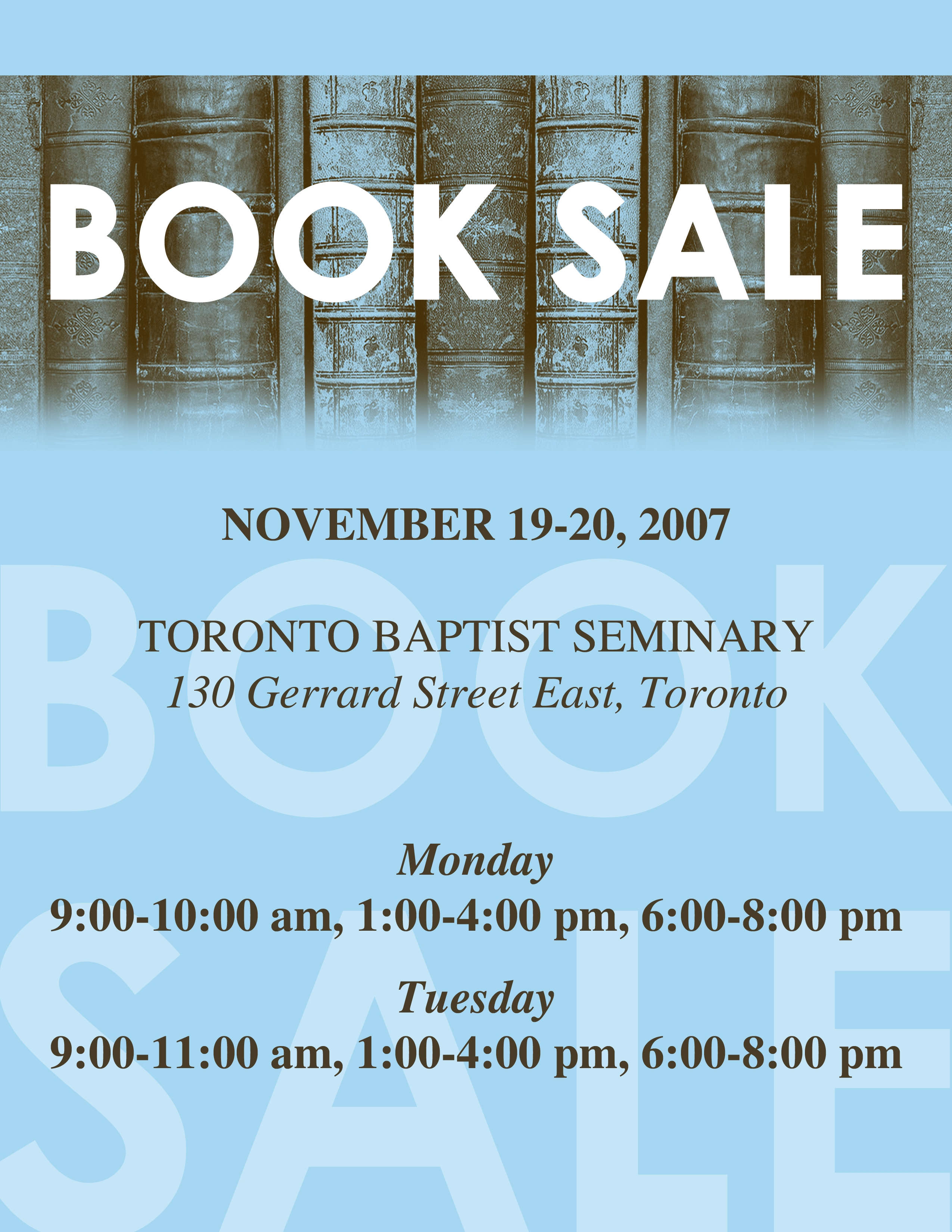
TBS Book Sale!!

October 24, 2007

book-sale2.jpg


Come one come all to the Toronto Baptist Seminary and Bible College book sale! All proceeds go to the Peter MacGregor Library at TBS.


We have been fortunate to receive the entire contents of a solid Christian bookstore as a gift to the school. Most of the books are new and there is some used as well. You will find great deals here on fantastic books! This will include commentaries, theological texts, and other solid reference materials!


Only cash or cheque will be accepted. To be held at Jarvis Street Baptist Church (130 Gerrard Street East, Toronto).


For more information please phone 416-925-3263 or e-mail inquiry@tbs.edu.


Promise Unfulfilled: The Failed Strategy of Modern Evangelicalism – A Review by Andy Naselli

October 19, 2007

promis_unfulfilled.jpg

Over at Andy Naselli’s blog, he has a very thorough and excellent review of my former theology professor at DBTS’ most recent book. Promise Unfulfilled: The Failed Strategy of Modern Evangelicalism by Rolland D. McCune is an excellent recent treatment that looks at Evangelicalism from a Fundamentalist perspective. Naselli’s review is excellent. But even better, McCune replies! This is great interaction over this excellent book. Check it out here.


Like Free Books?

September 5, 2007

sept Giveaway

 Tim Challies is at it again! Click the above link for your chance to win all 6 volumes of the Reformed Expository Commentary series! It is a fantastic series that you will all enjoy! Good luck in the contest!


Understanding Edwards can be Difficult…

August 27, 2007

9781581349320.jpg


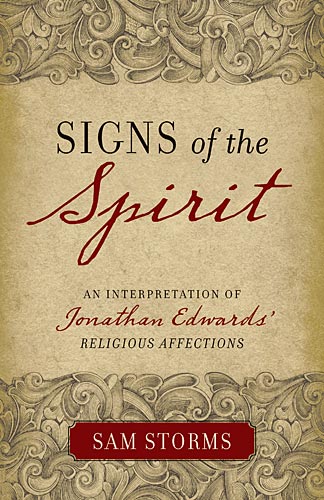
Sam Storms is no slouch when it comes to Jonathan Edwards. Edwards was the subject of both his Master’s thesis and his PhD dissertation. Yet, even he recognizes that Edwards’ can sometimes be difficult to understand. And, one of his most important works, Religious Affections, can be sometimes one of the most difficult. I recall when my father and I were in seminary our Hermeneutics professor had a contest with students to see who could read more of the Bible (from Genesis all the way through); he or the students. My father beat him near the end of the semester. The prize was a copy of Religious Affections. Needless to say, after reading it he concluded he did not understand any of it and thought perhaps there was little good in reading Edwards if it were so difficult.


I have shared those thoughts. Edwards is indeed difficult! But what we have now is something we did not have before. We now have Sam Storms’ Signs of the Spirit: An Interpretation of Jonathan Edwards’ Religious Affections. This book (available here) is a wonderful help in understanding this difficult but incredibly important book. I purchased a copy with my 25% discount card for being at the Andrew Fuller the Reader conference from the LifeWay Campus Store at SBTS (guess you should have all been at the conference)! Having skimmed it I have found that it is an incredibly helpful volume that will aide my own understanding of Edwards’.


In it, he offers paraphrases of Edwards’ writings interposed with his own thoughts.  Storms is a master of exegeting Edwards and making him clearer for us. The book is worth its price for the second part where Storms offers personal applications of Edwards’ work. Storms writes with a pastor’s heart and with a superb historian’s skill. I recommend highly this volume for anyone who wants to better understand Edwards’ especially on this most important topic of the Religious Affections.